




A newly completed student centre at The Scots College in Bellevue Hill has prompted commentary on architectural authenticity, educational equity, and the role of tradition in school design.
A Library Recast in Stone
The John Cunningham Student Centre marks a significant transformation of the former Stevenson Library, originally completed in 1988. Once described as a stark, flat-roofed structure lacking character, the library was considered unsuitable for a contemporary educational environment.
Rather than proceed with a full demolition, sections of the original building were retained. This decision, based on the structural viability of the existing form, required complex integration with the new design, which adopts a historic architectural style.

A Calculated Departure from Modernism
The centre features Scots Baronial architecture, a revivalist style from the 19th century that draws on medieval and Renaissance influences. Key design elements — including stone arches, turrets, and a cantilevered stair — were constructed using genuine materials such as structural stone, Welsh slate, and bronze.
Led by architect John Cockings of JCA Architects, the project drew inspiration from Craigends House in Scotland, the ancestral home of alumnus John Cunningham’s family. This stylistic choice diverges from prevailing global design trends, positioning the building as a conscious departure from the uniformity of modernist architecture.
Revisiting Authenticity in Design

The $60-million student centre has drawn mixed reactions. Some in the architectural community labelled the design a “pastiche” — a term commonly applied to works perceived as stylistically imitative. Others, however, have noted the project’s detailed execution and commitment to architectural tradition as a considered counterpoint to contemporary norms.
Beyond the design, Scots College explains their vision:
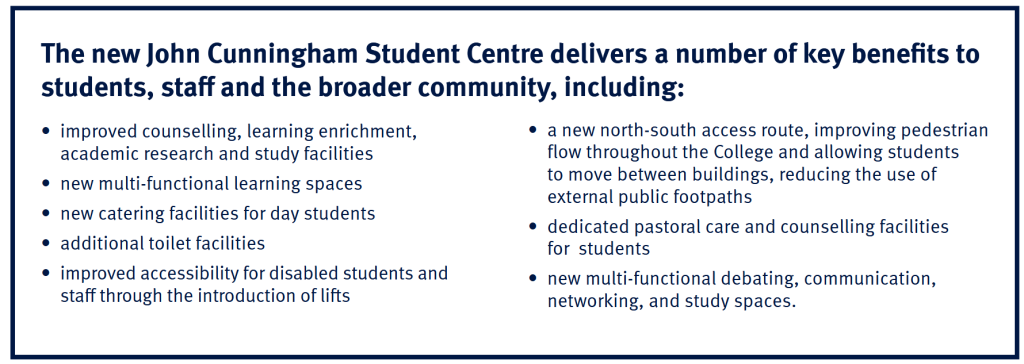
With the generosity of our majority donor, Mr John W Cunningham, AM SCM (’50), our vision for the John Cunningham Student Centre is far more than an impressive building. Housed within it are learning spaces and spaces for students to meet and learn together. This allows for the normalisation of counselling and other support services to ensure that all students receive the proactive resources that they need to be not just a student, but to flourish and thrive and graduate as fine young men.
Scots College
The project has become a reference point in ongoing architectural commentary about authenticity, originality, and the role of style. The decision to embrace a historical form challenges entrenched values that favour abstraction and minimalism, questioning whether historical references in architecture should be dismissed or embraced.
Rather than adhering to the aesthetic conventions of current educational buildings, the structure incorporates ornamentation, locality, and historical symbolism, reintroducing design elements often omitted in contemporary construction.
A Statement Beyond Its Walls
While the execution of the building was noted in some architectural commentary, concerns persist regarding cost and access. Now housing the school’s library, pastoral care rooms, and professional learning spaces, the facility reflects values of wealth, permanence, and tradition often associated with elite institutions.
The John Cunningham Student Centre stands as more than a facility upgrade. It reflects an institutional identity rooted in heritage and permanence. Whether it remains an exception or influences broader trends in educational architecture, the conversation it has sparked in design circles underscores its symbolic weight.
Editor’s Note: This article has been amended to correct a previous version which stated that $17 million of the project cost was publicly funded. The Scots College has clarified that no public funds were used to fund the construction of the John Cunningham Student Centre. “The Scots College receives no government funding for capital work and therefore building work must be funded from either donations or bank loans.” – FAQ, The John Cunningham Student Centre
Published 13-July-2025. Updated 14-July-2025


